How can you cheat in Chess.com and what actually happens when you do
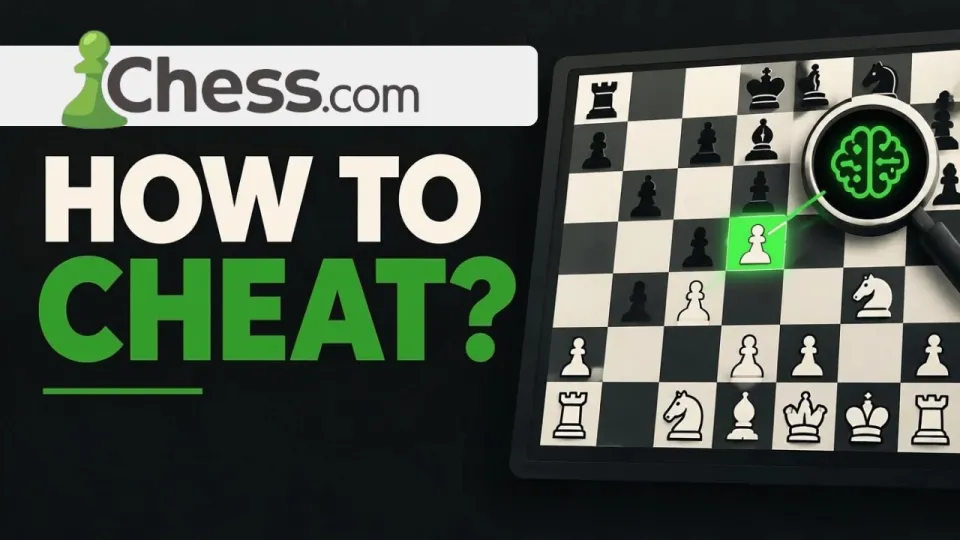
Video: How to cheat in Chess.com (Chess.com cheats)
· based on the channel Matyc
Key takeaways
- Chess.com cheating tools are typically browser userscripts or extensions that overlay a chess engine's suggested move on the live board.
- The most common distribution route is a userscript manager such as Tampermonkey plus a script hosted on a third-party site.
- Chess.com's fair-play detection combines engine-correlation analysis, move-time statistics and manual review of reported accounts.
- Consequences range from rating refunds for opponents to account closure and bans from prize events.
- No overlay changes the underlying server-side game record, so the moves remain permanently tied to the account.
Cheating on Chess.com usually means running a third-party browser script or extension that reads the position on screen and displays a chess engine's recommended move next to the board. The most widely shared version of this is a userscript installed through a browser add-on manager and loaded from a distribution page such as the xMods Chess.com cheat listing, which hosts the script file and install instructions. It does not modify Chess.com's servers in any way; it only adds a visual layer on top of the page in your own browser, which is exactly why it is detectable and why accounts using it get closed.
What a Chess.com cheat extension actually does
A Chess.com cheat extension is a client-side overlay, not a hack of the game itself. The script hooks into the page, reads the piece positions from the board element or the site's internal game state, converts that into a FEN string, sends it to an engine running locally or in a worker, and renders the top move as an arrow or a highlighted square. Nothing is uploaded to Chess.com and no result is altered on the server, so the entire advantage depends on you physically playing the engine's move before the clock runs out.
In practice the pieces involved are:
- A userscript manager in the browser, most often Tampermonkey, which is what the "chess.com tampermonkey" searches refer to.
- The script file itself, downloaded from a third-party page rather than from Chess.com.
- An engine, typically a Stockfish build compiled to WebAssembly so it can run inside the browser tab.
- A settings panel where you choose search depth, number of lines and how the arrows are drawn.
Because everything runs locally, the overlay works in bullet, blitz, rapid and daily games alike, and it also works on the analysis board. That convenience is the trap: the same local execution leaves timing fingerprints that are trivial to compare against a baseline.
Step-by-step: how the userscript method is set up
The setup for a Chess.com cheat script follows the same pattern regardless of which distribution page you use. The general sequence looks like this:
- Install the Tampermonkey extension for your browser from the official store listing.
- Open the script's distribution page and copy or download the .user.js file.
- In Tampermonkey, create a new script and paste the code, or drag the file into the extension's dashboard to register it.
- Confirm the script is enabled and that its match rule covers chess.com.
- Open Chess.com, start a game or the analysis board, and look for the overlay panel or arrow that the script injects.
- Adjust engine depth and display options in the script's own settings menu.
If nothing appears after step 5, the usual causes are a disabled script, a browser that blocks userscripts on that domain, or a Chess.com front-end update that broke the selectors the script relies on. That last point is the recurring failure mode: any change to the board's markup can silently kill an overlay until its author ships a fix.
Why the anti-cheat still catches engine users
Chess.com's fair-play system does not need to see your browser to flag an account. It compares your moves against engine evaluations across many games and looks for a statistical signature: a high percentage of top-engine choices in complex positions combined with unusually consistent thinking time. Human players blunder, hesitate and speed up in simple positions; a player relaying engine output does not, and the mismatch shows up quickly in aggregate.
Several other signals feed the same model:
- Move-time uniformity, where every move takes a near-identical number of seconds regardless of position difficulty.
- Strength jumps, where an account's accuracy leaps far beyond its established rating history.
- Opponent reports, which trigger manual review of the flagged games.
- Device and account linkage, which ties suspicious accounts to previously closed ones.
Detection is retrospective, which is why cheating accounts often win for a while and then lose everything at once, including the rating their opponents lost to them.
What happens to a Chess.com account that cheats
When Chess.com closes an account for fair play, the standard package is account closure, removal from leaderboards, and rating refunds to affected opponents. In prize events and titled-player cases the consequences extend further, up to bans from the platform's competitive ecosystem. Because the game record lives on the server, there is no way to scrub the evidence after the fact, and appeals rarely succeed when engine correlation is strong.
There is also a practical cost that does not appear in any ban notice: the rating becomes meaningless to the person holding it. A 400-point climb produced by an overlay teaches nothing about chess, and the moment the script breaks after a site update, the account falls back to its real level in public view.
Common questions from people trying Chess.com cheats
The most frequent confusion is about how the tool behaves inside a live game rather than on the analysis board. An overlay needs the board to be rendered and the game to be in progress; on the start screen or in the lobby there is nothing to read, so the panel looks inert. Once a game begins, the arrow appears after the engine finishes its search, which at higher depth settings can take several seconds, and in bullet that delay alone can cost the game.
The second recurring issue is installation failure. A script that does not show up is almost always a userscript manager problem, not a Chess.com problem: the extension is disabled, the script's match pattern does not include the domain, or the browser is running in a mode that blocks injected code. The third is availability, since distribution pages and script repositories go offline regularly, and a dead link is indistinguishable from a broken script to a new user.
Risks beyond the ban
Third-party userscripts run with broad permissions inside the browser tab they are injected into. That means a script from an unknown distributor can read page content, including session cookies, and can be updated remotely by its author at any time. Antivirus tools rarely flag userscripts because they are plain JavaScript, so the burden of trust falls entirely on the person installing them. For anyone weighing the trade, the honest calculation is a temporary rating bump against account loss plus unknown access to a logged-in session.
Where to find the script and what the breakdown covers
The distribution page linked in the video breakdown is the xMods Chess.com cheat item, which hosts the userscript file and the installation notes for the Tampermonkey method. That page is the single external resource referenced in the walkthrough; everything else in the method is standard browser tooling and a Stockfish build.
Summary
Cheating on Chess.com is technically a browser overlay problem, not a server exploit: a userscript reads the board, an engine suggests a move, and the player types it in. The method is easy to install and easy to detect, because Chess.com's fair-play analysis works on move statistics that engine users cannot disguise over a large sample. The video breakdown by the channel Matyc walks through that userscript route, and the script itself is distributed through xMods for anyone who wants to see exactly what the tool does before deciding. The realistic outcome for accounts that use it is a closed profile and refunded opponents, not a permanent rating gain.
Questions & answers
How do I actually use a Chess.com cheat during a live game?
Start a normal game on Chess.com with the script enabled, and the overlay panel or arrow appears once the board is rendered and the engine has finished its search. On the analysis board it works the same way but without a clock. Higher depth settings mean a longer wait per move, which makes the tool impractical in bullet.
Why does the cheat not show up after I install it?
The usual causes are a disabled Tampermonkey extension, a script whose match pattern does not cover chess.com, or a browser mode that blocks injected code. A Chess.com front-end update can also break the selectors the script depends on until the author publishes a fix.
Does Chess.com detect userscripts and engines?
Yes, though usually after the fact. Fair-play analysis compares your moves to engine evaluations across many games and combines that with move-time consistency, accuracy jumps relative to rating, and opponent reports. Strong correlation leads to account closure and rating refunds for opponents.
Is a Chess.com cheat extension safe to install?
A userscript runs with broad permissions in the tab it is injected into, so it can read page content including session data, and its author can push updates remotely. Antivirus software rarely flags plain JavaScript, so the risk assessment is entirely on the person installing it.
Source: How to cheat in Chess.com (Chess.com cheats) · Markdown version